
Service area
Solar pool heating in the High Desert
Up here the sun is free and the nights take it straight back. That's not a reason to skip solar — it's the whole argument for it. We've been designing and installing these systems as a family since 1981, and the drive up the pass is a normal week for us.
The honest version
Your pool isn't fighting the desert. It's fighting the elevation.
Victorville, Apple Valley and Hesperia sit near 3,000 feet. Yucca Valley is higher still, around 3,300. That altitude is why a July afternoon can hit 100 degrees and the same pool feels cold enough to argue about at seven the next morning.
Thin, dry air at elevation doesn't hold the day's heat. Once the sun is off the water, your pool radiates straight up into a clear night sky with nothing overhead to stop it, and dry air pulls water off the surface all night — evaporation being the single biggest way any pool loses heat, anywhere. A 40-degree drop between afternoon and dawn is ordinary up here. Your pool feels every one of those degrees.
So the question was never whether there's enough sun. There is more usable sun above the pass than almost anywhere we work. The question is how much of today's heat is still in the water tomorrow morning — and how many weeks of spring and fall you get to actually use the pool you're already paying to maintain.
What it's for
This is where solar has the most to prove — and the best case for itself
Strong sun, clear sky, long exposure. An array up here works harder in a day than the same array on the valley floor. It just has to be designed for the night that follows.
Sized for the swing, not the average
A High Desert pool starts every morning behind. That argues for more collector area than the same pool needs in Redlands, so we design to the overnight loss rather than to a seasonal average that hides it.
Mounted and strapped for wind
Wind is the real design constraint above the pass. It changes how an array is anchored, how the headers run, and how the whole thing is strapped down — details that decide whether a system is still tight in ten years.
Ground racks when the roof won't do
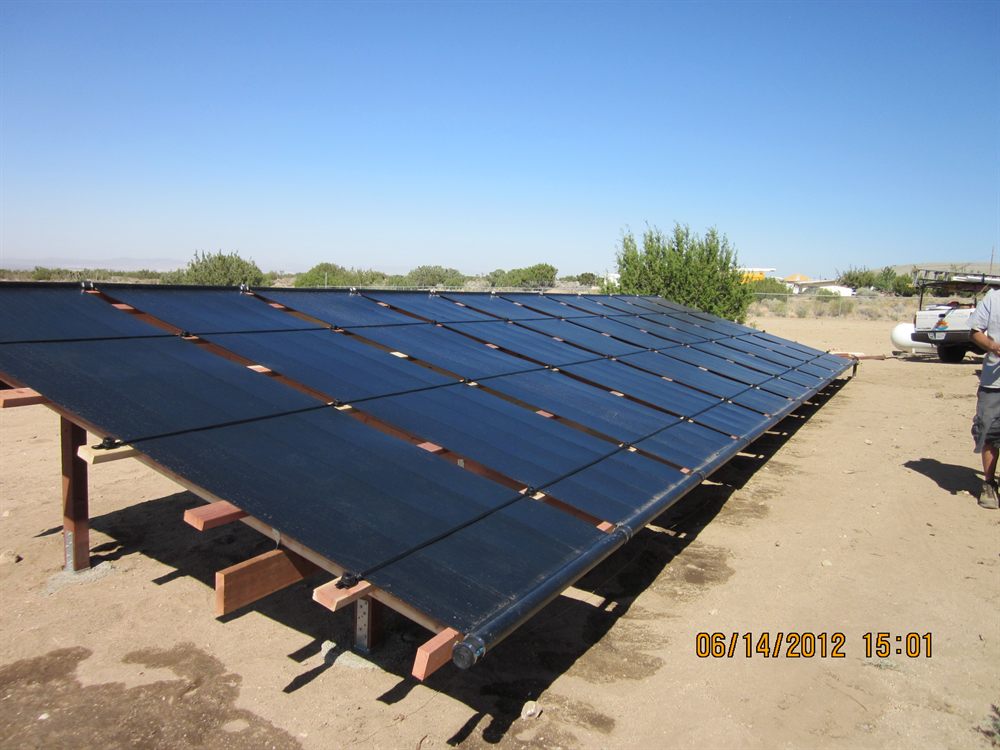
Lots are big up here and roofs are often low, small, or pointed the wrong way. A rack along the fence line or beside the equipment pad frequently beats a compromised roof array outright.
The question everyone asks second
What happens to the panels when it freezes?
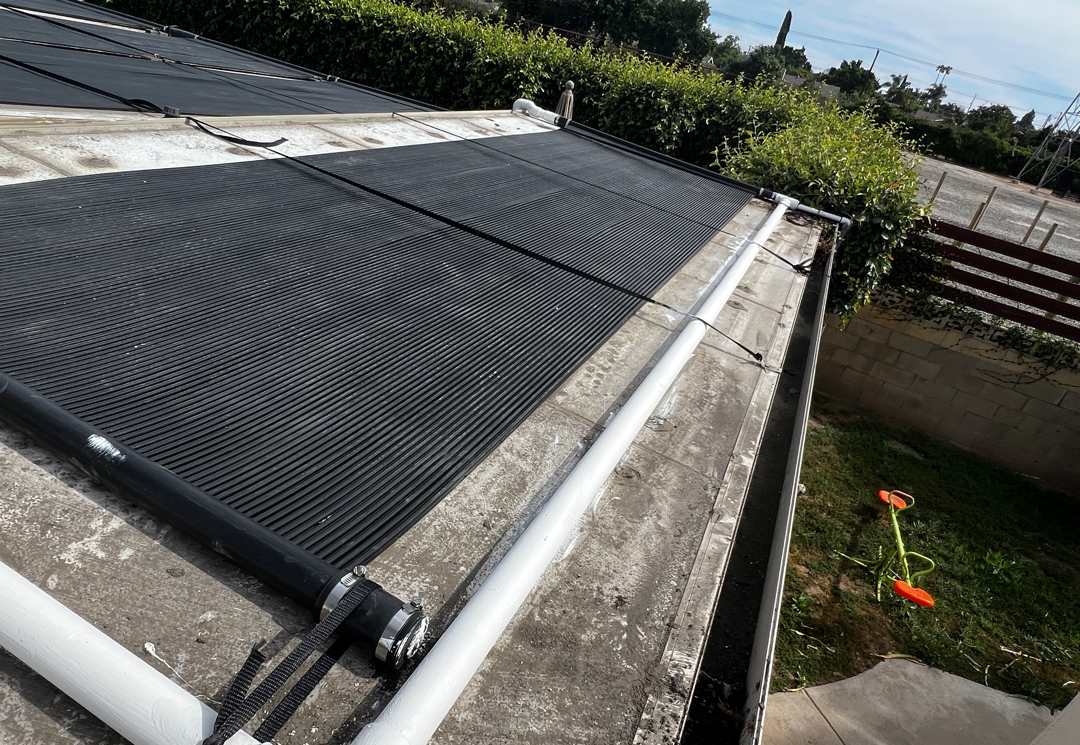
Nothing, if the system was plumbed properly. These collectors aren't holding water when they're off. A vacuum relief valve at the top of the array lets air in the moment the pump shuts down, and the panels drain back to the pool by gravity. There's nothing up there to freeze overnight.
What that depends on is slope. Every run has to be pitched so it actually empties, with no low spot quietly holding a cupful of water through a 22-degree night. It's an easy thing to get right on installation day and an expensive thing to discover in February, which is a fair reason to care who does the work — not just what the panels cost.
It's also why we'd rather look at an inherited system than guess about it. If there are panels already on your roof and nobody can tell you how they were run, an inspection is the cheapest answer you'll ever buy.
Say the quiet part
At this elevation, a cover isn't optional advice
We don't sell pool covers. We'll still tell you to get one, and we'll be more insistent about it up here than anywhere else we work.
Collectors and a cover solve two halves of one problem. The panels put heat in while the sun is up; the cover is what stops the night taking it back out. Everywhere else that pairing is a nice improvement. Above the pass, with a 40-degree overnight drop and air dry enough to strip the surface, it's the difference between a system that impresses you and one that leaves you puzzled every morning.
A homeowner who buys an array, skips the cover, and then wonders why the water is cold at sunrise is a homeowner we've failed. We'd rather have that conversation before you spend anything than after.
Two deserts, one page
Where "the High Desert" actually means us
The Victor Valley is a standing part of our service area. The Hi-Desert around Yucca Valley is real work too, just further out and scheduled accordingly. Here's the straight version of both.
The Victor Valley — routine runs
Apple Valley, Hesperia and Victorville are normal work for us, not favors. Apple Valley alone accounts for more of our book than most cities on the valley floor. We're regularly in Oak Hills, Phelan and Adelanto as well.
That matters most after the sale. A 12-year panel warranty is only worth something if somebody will drive up the Cajon Pass to honor it — and we do, for our own installs and for systems somebody else put up.
Same crew, same standard, same phone number as every job we run down the hill. We don't subcontract and we don't run a separate branch up here.
The Hi-Desert — planned trips
Locals call it the Hi-Desert; the maps call it the Morongo Basin. Either way it's Yucca Valley, Joshua Tree, Morongo Valley, Landers and Pioneertown, with Twentynine Palms the last stop out that way.
We reach this side from the desert rather than over the pass, and it's the far edge of our range — so expect a scheduled date rather than a same-week visit. You'll get a real date, not a vague window, and if we can't do right by you we'll say so on the phone.
Near the edge and not sure? Call and ask — it's a two-minute conversation and it beats guessing.
Down on the valley floor instead? That's our Palm Springs and Coachella Valley page. Below the pass is San Bernardino County. Everything at once is on the service areas page.
What we do here
Every service we run comes up the hill
New systems are most of it, but plenty of High Desert pools already have an array on them — and this climate is hard on anything left outdoors.
New installations
Our own crew, usually one to two days on site, exposed plumbing painted to match the house. 12 years of panel warranty and a full year from us on everything we touched.
See how an install goesLeak repair
Hard sun and hard freezes are rough on plumbing and hardware. We find the leak, fix it, and pressure-test before we call it done — whoever installed it.
Schedule a repairWarranty replacement
Panels carry a 12-year manufacturer warranty. If yours are still covered we handle the inspection and the claim paperwork, and swap like for like.
Check your warrantySystem inspections
Bought a house with panels already up there, or wondering whether an old array is worth keeping? We'll tell you straight, including when it isn't.
Book an inspectionPanel removal
Re-roofing, or finished with a dead system somebody else installed? We pull the array and plumbing off cleanly and leave the roof ready to work on.
Arrange a removalPrice it yourself
Find your house on satellite imagery, lay the array out yourself, and get a real number in a few minutes. No appointment, no salesperson.
Open the system designerAlready have a system that's dripping or dead? Send a repair request, an inspection request, or a removal request and we'll come back with a time.
Real numbers, honestly labeled
We publish live readings — from a valley-floor pool, not a High Desert one
We run a working system wired to a weather station and publish its water temperature minute by minute on our data page.
Those sensors sit on an inland valley system in Riverside County. It reads like a Redlands or Chino pool, not an Apple Valley one — up the hill you'd see a deeper overnight dip than the chart shows. We'd rather say that out loud than let a graph oversell your morning.
FAQ
High Desert questions we get
The cold nights are the reason to have it, not a reason to skip it. Your pool starts every morning behind, and an array up here has more to work with than one on the valley floor — strong sun, clear sky, long exposure. What the climate does demand is sizing honestly for that nightly loss, and using a cover. The panels add the heat; the cover is what stops you paying for it twice.
Not if the plumbing was pitched right. A vacuum relief valve at the top of the array lets air in when the pump stops, and the panels drain back to the pool on their own — so there's no water sitting up there overnight to freeze. The failure mode isn't cold, it's a low spot in a run that never fully empties. That's an installation-day detail, which is exactly why it's worth asking who's doing the work.
Regularly, and for service afterward — not just for the install. The Victor Valley is a standing part of our service area: Apple Valley, Hesperia, Victorville, Oak Hills, Phelan and Adelanto are all normal work. That second part matters more than it sounds, because a warranty is only useful if somebody will drive up the pass to honor it.
We cover all three, plus Morongo Valley, Landers and Pioneertown. We reach that side from the desert rather than over the pass, and it's the far edge of our range — so those are planned trips with a date on them rather than same-week visits. Say where you are when you call and we'll tell you honestly how soon we can be there.
Not if it's built for it. Wind is what separates a High Desert install from a valley one: it changes how the collectors are anchored, how the headers run, and how the array is strapped down. On open lots we'll often recommend a ground-mount rack instead of the roof — easier to anchor, and easier to service in ten years.
Often, and up here it's frequently the better answer anyway. A rack along the fence line, beside the equipment pad, or set into a slope does the same job as a roof array, and lots above the pass usually have room for one. If the roof is still the right call but faces east or west, that works too — it just needs extra collector area. There are several ground mounts in our install gallery, and more general questions live on the FAQ page.
Get the season back
Free, no-obligation estimates from Adelanto across to Apple Valley and out to Yucca Valley — and a straight answer if it isn't worth doing.
Also serving San Bernardino County below the pass, Riverside County, Orange County, and Palm Springs and the Coachella Valley — C-46 solar contractor, license #924564, family in solar since 1981.