
Repair
Solar Pool Heater Repair
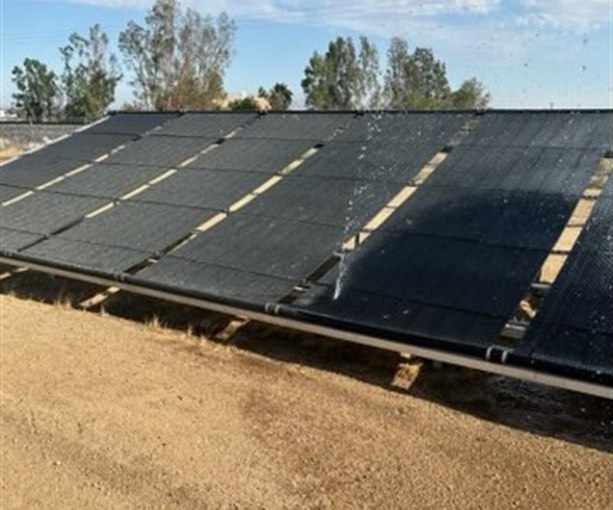
Pool not warming up, or a leak somewhere on the roof? We find the actual problem and fix it — panels, plumbing, valves, or controls — on any solar pool heating system in Southern California, no matter who installed it.
Before you call
Three things you can check yourself in five minutes
A good share of "my solar stopped working" calls turn out to be a switch in the wrong position, or water that was never a leak. All three of these are done standing on the ground — and we'd rather you find one on a Saturday than wait until Monday for us to find it for you.
1. The system won't turn on
Start at the control box. Check that it's powered up and switched on, and that the set-point — the temperature you're asking it to reach — is at least 5°F above where the pool is sitting right now. A set-point sitting a degree or two over the pool gives the controller almost nothing to ask for.
Then look at the actuator: the motor sitting on top of the valve that decides whether water goes straight back to the pool, or up to the panels first. The switch on that actuator is the single most common false alarm we see. It has three positions — on 1, on 2, and a deactivated position that stops it accepting commands and moving at all.
Which of on 1 and on 2 is correct depends on how your system was plumbed, so there's no universal answer. The principle is the same on every one, though: in the right position the valve sends water to the roof when the controller calls for heat, and in the wrong one it does exactly the opposite — shutting off when it should be heating, and turning on when it shouldn't. If that switch has been bumped, flipping it back is the whole repair.
2. Water first thing in the morning
If the only moisture you're finding is early in the morning, there's a good chance it's condensation rather than a leak — cool panels, damp overnight air, the same thing that leaves your car wet in the driveway.
Check again in the afternoon, with the system running. Dry by then, and nothing is leaking. Still wet — or dripping — once the roof is warm and the pump is pushing water through the array, and you've confirmed a real leak worth calling about.
3. A sensor fault, or readings that make no sense
Most controllers flag a bad sensor outright, with an indicator light or an error on the display. The other tell is a temperature that simply can't be true — a roof reading of 30°F in July, a pool number that never moves, or two readings that don't match anything you can feel in the water.
Check the sensor wire where you can see it, and make sure nothing has been pulled loose or disconnected at the controller. Wires get bumped during landscaping, worked free by years of heat cycling, and chewed by rodents — and a wire pushed back into place costs nothing.
If the connections are sound, the sensor or its wire likely needs replacing. That's a bigger job than the two above, but it's doable if you're handy — and a short visit for us if you'd rather not.
Not sure what you're looking at?
Give us a call — we're happy to walk you through these on the phone, and if it needs a tech we'll get one scheduled while we're talking. If you're pretty handy, our self service guides go further, part by part.
Where do-it-yourself stops
The three checks above are safe from the ground. The roof is the real risk — panels often sit on pitched tile or shingle, and the panels as well as the roof can be slick, especially if there is moss. Only experienced professionals who do this every day, with the right harness and the right ladder, should be on a roof. Anything that puts you up there is ours — that's what a licensed C-46 solar contractor is for.
Common failures
What usually goes wrong
Forty-odd years of service calls, and the list is shorter than you'd think. These are the failures we see over and over — and most of them are a repair, not a replacement.
The valve isn't sending water to the roof
The most common cause of "my solar stopped working." A manual diverter left the wrong way, an actuator switch that got bumped, or an actuator that's burned out or lost its signal — any of them leaves the panels dry while everything else looks fine. Actuators are a straightforward swap.
Controller set-point or sensor trouble
Controllers compare a roof sensor to a pool sensor to decide when the sun can help. A drifted or failed sensor, a chewed wire, or a set-point knocked down below the pool temperature keeps the system off on a perfectly sunny day.
A check valve stuck open
Check valves keep water heading one direction and stop the array draining back through the plumbing. When one sticks open and stops holding, water runs back the way it came — so you get weak heating, air noise in the lines, or water that won't stay up in the panels.
A leaking vacuum breaker
At the high point of the array sits a valve that lets air in so the panels drain when the pump stops. It's a common source of that mystery drip off the roof — and one of the cheapest parts on the system.
Low flow from a dirty filter or tired pump
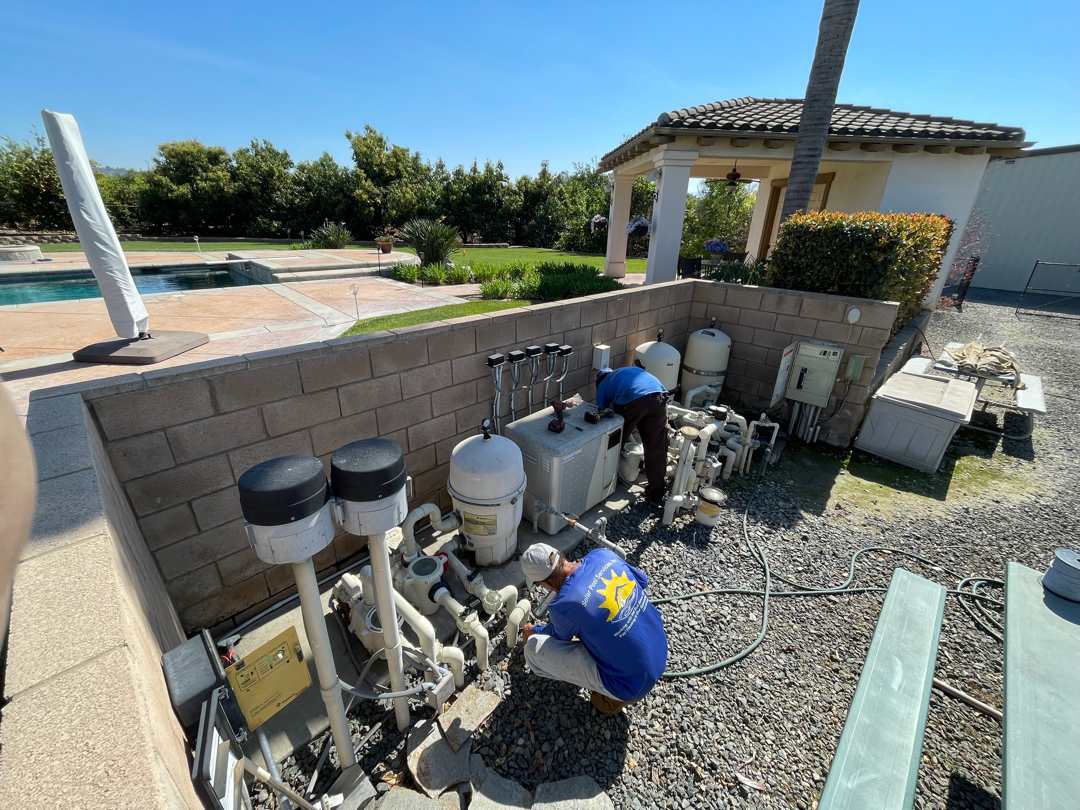
Solar heating is a flow problem before it's a sun problem. An overdue filter, a clogged impeller, or a tired pump can't push enough water to the roof, so heat never comes back down. Often the fix is at the pad, not on the roof.
Scale and mineral restriction
Over the years, minerals in pool water leave deposits inside the small tubes running across each collector. Restricted panels heat unevenly and add back-pressure on the pump. Sometimes serviceable — on an older array, usually a sign of age.
Leaks in the body of a panel
A leak in the tubes running across a collector sounds like the end of that panel, and usually isn't. Panel bodies repair well — we fix them in place far more often than we replace the panel — so a wet stripe down your roof is rarely the expensive news it looks like.
UV embrittlement and header cracking
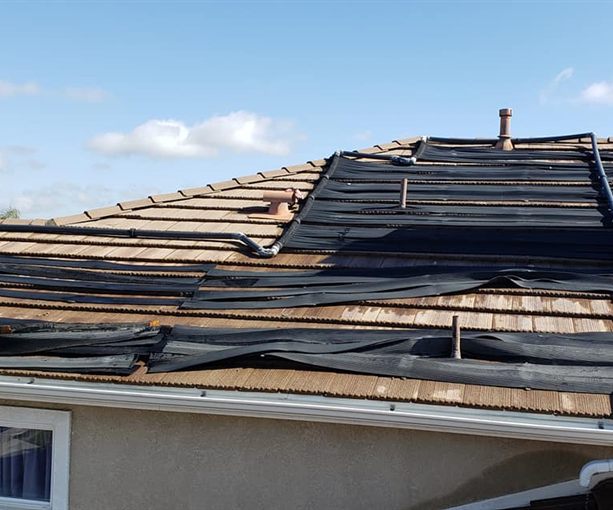
Panels are built UV-stable, but after twelve to twenty years in the Southern California sun the polymer hardens. The headers — the thick tubes at each end — are where it shows first, as hairline cracks that weep whenever the system runs. Unlike a body leak, a cracked header means swapping that panel.
No matter who put it up there
We repair systems other companies installed
Most solar installers will only touch their own work. We're not most installers — servicing other people's systems is a big part of what we do, and always has been.
Solar pool heating companies come and go. Plenty of the arrays on Inland Empire roofs were put up by outfits that closed years ago, or by a pool contractor who did one and never did another. Something fails, the homeowner calls the number on the old invoice, and gets a disconnected line.
Call us instead. Every brand of collector, every kind of controller — on tile, shingle, flat roofs, ground mounts and racks. We'll tell you what it is, what it costs, and whether it's worth doing, even when the honest answer is that it isn't. Not sure what you've inherited? A system inspection checks the whole thing and hands you a plain-language report.
How it works
What happens when you call
No runaround. Tell us what you're seeing and we'll take it from there.
Tell us what you're seeing
Dripping panels, wet roof tiles, a pool that won't warm up. Send us the details or call — that's usually enough to know where to start and what to bring.
We diagnose on-site
A tech checks panels, plumbing and valves on the roof and at the equipment pad, then runs the system under pressure. We find the actual problem, not the symptom — and you get the price before any work starts.
Fixed and flowing again
Most repairs are done the same visit. We run it and test it before we leave, so you know it's holding.
Any solar pool system
What we repair
- Leaks in panel bodies, couplers and PVC plumbing
- Diverter valves and failed valve actuators
- Check valves and vacuum relief valves
- Controllers, sensors and automation faults
- Low flow traced back to the equipment pad
- Worn straps, clamps and mounting hardware
- Freeze damage, and drain-downs before winter
- Single panel swaps, in or out of warranty
- Systems installed by others — every brand, welcome
The honest answer
Repair it, or replace it?
Panels last twelve to twenty years. Where yours sit in that window matters more than what's leaking today — so here's the rule we use, before we quote you anything.
Usually worth repairing
- Leaks in the body of a panel — the tubes across the mat
- Anything in the plumbing — pipe, couplers, fittings, roof runs
- Valves of every kind: diverter, check, vacuum relief
- Actuators, controllers, sensors and wiring
- Mounting hardware, straps, roof penetrations
- One failed panel in an otherwise healthy array
Usually a replacement conversation
- A cracked header — that panel gets swapped, not patched
- Leaks turning up in several panels within one season
- Panels gone hard, chalky or brittle to the touch
- Repair costs approaching the price of a new array
Check the warranty before you pay for anything
Every panel we install carries a 12-year manufacturer's warranty, and our own work carries a full year on parts and labor. Inside that 12-year window the panel itself is covered — the manufacturer replaces it, and we handle the inspection and the claim — so what you'd be paying for is the labor to get the new one up there, not the panel. If your system came from someone else, its panels may still carry a warranty of their own; always worth checking first, and we'll put that claim paperwork together too. You shouldn't have to argue with a manufacturer yourself.
When an array really is at the end of its life, we'll say so plainly rather than sell you a repair that buys one more summer — see replacement, or removal if a dead system is coming off for good. To price a new one first, our online system designer builds an estimate from satellite imagery of your roof in a couple of minutes.
Where we go
Repair service across Southern California
Our shop sits at the Riverside and Perris line, in the middle of Riverside County, and the repair trucks work outward from there every day.
Closest to home that's Riverside County — Riverside, Moreno Valley, Perris, Corona, Menifee, Murrieta, Temecula, Lake Elsinore and the surrounding communities — plus the north edge of San Diego County around Fallbrook, Bonsall and Rainbow. Across the Inland Empire we cover San Bernardino County — Redlands, Rancho Cucamonga, Fontana, Ontario, Chino Hills — and up the pass into the High Desert around Hesperia, Victorville and Apple Valley.
West we work into Orange County, and east to Palm Springs and the Coachella Valley. We also reach Indio and Coachella, Yucca Valley and Twentynine Palms, and the San Gabriel Valley. The full map is on our service areas page, and if you're near the edge, call and ask.
FAQ
Repair questions
Yes, and it's a large share of our work. Most installers will only service their own jobs. We service every brand of collector, controller and valve, regardless of who put it up there or how long ago they went out of business — and if the panels are still under a manufacturer warranty, we'll handle the claim paperwork too.
Usually repaired. Solar panels are far more repairable than most people expect — a leak in the body of the panel, meaning the small tubes running across the mat, is generally fixable in place, and so are coupler, plumbing, valve and fitting leaks. The exception is the header, the thick tube at either end. A cracked header isn't something we can patch honestly, so that panel gets swapped instead — and it's often just the one. If it's still inside its 12-year warranty, the panel itself is covered, so you'd only be paying for the labor to fit it. See our panel replacement page.
In the order we check them: a valve not sending water to the roof — often just the switch on the actuator sitting in the wrong position — a controller set too low or knocked out of automatic, low flow from a dirty filter or a tired pump, air in the lines, or panels past their prime. A properly sized system runs roughly ten to fifteen degrees over an unheated pool — you can watch that gap minute by minute on our live data page, where we log our own Riverside County pool alongside an unheated control.
First make sure it's leaking. Damp panels first thing in the morning that dry out by lunchtime are usually condensation — check again in the afternoon with the system running before you shut anything down. If water is genuinely spraying or dripping while the system runs, then yes: turn solar off at the controller so the valve sends water straight back to the pool, or shut the pump off, and give us a call. Running a real leak wastes water and soaks the roof underneath it.
It depends on what failed — a vacuum breaker is one of the cheapest parts on the system, while a controller or a run of roof plumbing is a bigger job. What we can promise is the process: we diagnose on-site, tell you what it is, and give you the price before any work begins. Honest pricing, no hidden fees.
Less than most people expect. No fuel, no flame, no extra equipment running — so beyond keeping the filter clean there's nothing routine in season.
Several leaks in one season on an array well past its warranty years is usually the array telling you it's done — the polymer has hardened everywhere at once, so fixing one spot just moves the next failure along. We'll still come look and give you both numbers straight: repairs today, versus a new system. Plenty of customers repair for one more season on purpose; we'd just rather you choose it knowingly.
We repair throughout Riverside and San Bernardino counties, up into the High Desert, west into Orange County, and out through Palm Springs and the Coachella Valley. We also go as far as Indio and Coachella, Yucca Valley and Twentynine Palms, and the San Gabriel Valley. The map is on our service areas page; if you're near the edge, call and ask rather than guess.
Got a leak? We'll find it.
Tell us what's going on and we'll get a tech out to track it down — any system, any brand, whoever installed it.
Serving Riverside County, Orange County, and San Bernardino County — family in solar since 1981.