
Service area
Solar pool heating in Palm Springs
Out here the sun is never the problem. The night is. We design and install solar pool heating down the Coachella Valley floor — and we've been a family in solar since 1981.
The honest version
A desert pool has a different problem than an inland one
People call us from Palm Springs genuinely puzzled. The afternoon can sit at 108 degrees and the pool still feels cool at seven the next morning. Nothing is broken. That's just what a desert pool does.
The swing out here is enormous. Daytime heat is ferocious, but once the sun drops the air goes with it — and your pool sits under some of the clearest, driest night sky in the country, radiating heat straight up into it with nothing overhead to hold it in. Air that dry also pulls water off the surface hard, and evaporation is the single biggest way any pool loses heat.
So the desert question is almost never "is there enough sun." There's more than enough sun. It's how much of today's heat is still in the water tomorrow morning — and how many weeks of spring and fall you actually get to use the pool you paid for.
What it's for
What solar actually buys you in the desert
Not a hotter July. A longer season, steadier water, and no gas meter spinning to get it.
Spring and fall, not just summer
The shoulder seasons are where solar earns its keep. March, April, October and November all have plenty of sun; what they lack is a pool that holds it overnight.
Water that stops swinging
An automatic control lets you pick a temperature and holds the pool near it instead of letting it ride the weather. Cool mornings stop surprising you.
Sun resource that's hard to beat
Whatever else the desert is, it's an outstanding place to collect solar heat. Clear skies most of the year mean the panels spend more hours working than almost anywhere else we go.
Say the quiet part
In this climate, a cover does a lot of the work
We don't sell pool covers. We'll still tell you to get one.
Collectors and a cover solve two halves of the same problem. The cover stops the overnight evaporation draining your pool's heat into dry night air; the collectors put heat back while the sun is up. Run them together and each makes the other look better.
A homeowner who buys a system, skips the cover, then wonders why the water is cool at sunrise is a homeowner we've failed. We'd rather have that conversation up front.
On site
Desert houses need desert layouts
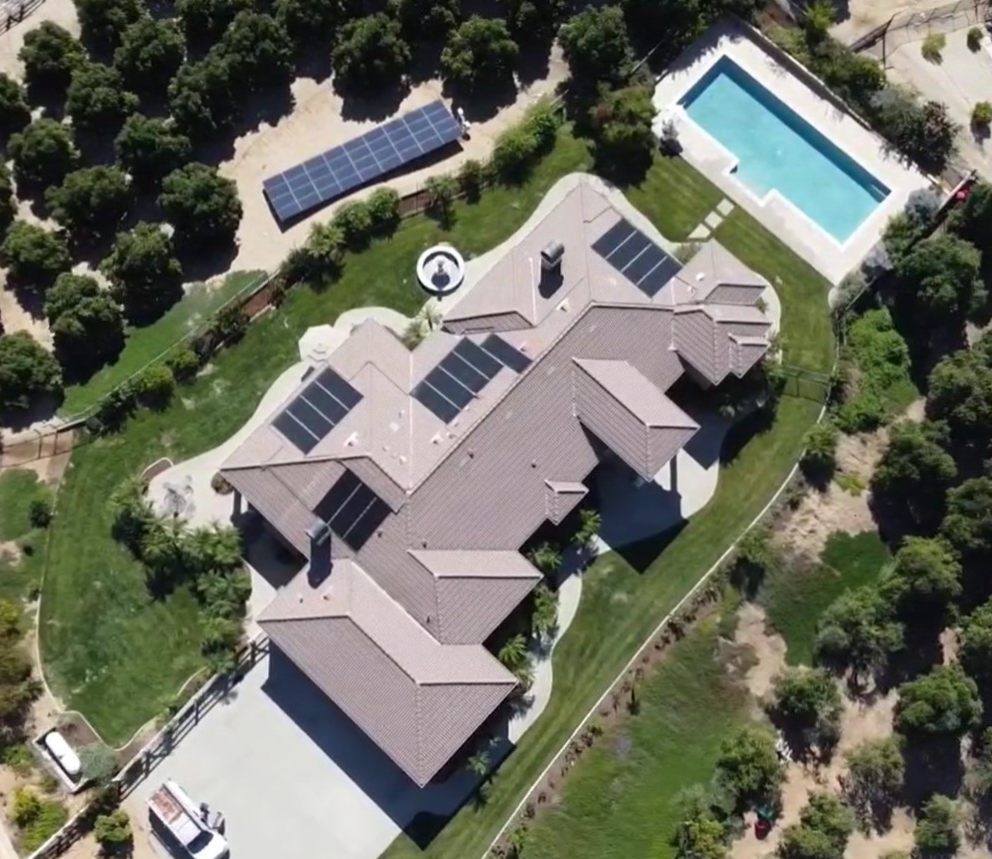
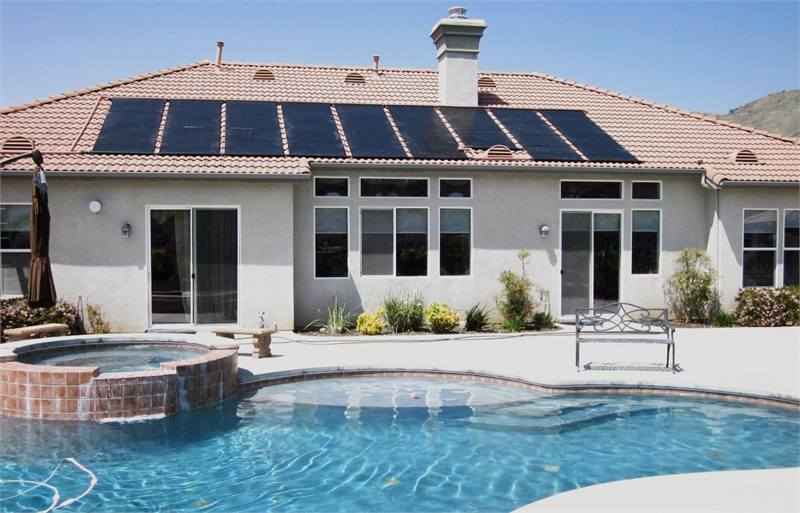
Rooftops down here look nothing like the Inland Empire's. Flat and low-slope roofs are everywhere, and plenty of valley properties sit on big open lots where the smartest place for a collector array isn't the house at all.
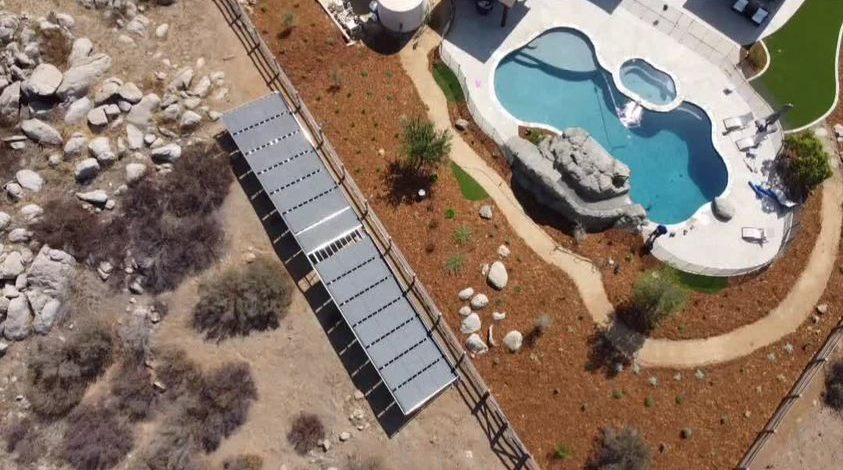
So a lot of our desert work is ground-mounted — arrays on timber racks along a fence line or out past the equipment pad, where the panels get clean southern exposure, stay within easy reach for service, and keep off a roofline the owner would rather leave alone. The gallery has several, and the array in the hero photo above is one of ours.
The sizing standard doesn't change: panel area equal to about 80% of your pool's surface, with more when the collectors have to face east or west instead of south. What changes is the mounting and the pipe run. Want to start on your own? The online system designer lays panels out on a satellite view of your house and prices it on the spot.
How far east we go
Down the Coachella Valley floor
We're based over the pass in Riverside, so desert work is a planned trip, not a drop-in. We'd rather be straight about that than pretend we're around the corner.
The top of the valley
Palm Springs is the center of it — a pool that runs cool at sunrise after a triple-digit afternoon is what people describe when they call. Cathedral City and Rancho Mirage sit in the same weather, with the same flat-roof and ground-mount realities, and Desert Hot Springs climbs onto the north side of the valley.
Palm Desert is where our regular run ends. Everything to this point is ordinary work for us — a scheduled date, our own crew, and the same warranty service afterward as any job down the hill.
Because desert trips get scheduled, you'll get a date rather than a vague window — and if we can't do right by you, we'll say so on the phone.
Further down: Indian Wells to Coachella
Past Palm Desert the long trips start. We do go — Indian Wells, La Quinta, Indio and Coachella — but that's the edge of our range rather than our back yard, so those are planned trips with a date on them.
The pools are the same; the drive isn't. If you're down that end, say so when you call and we'll tell you honestly how soon we can be there rather than booking something we'd have to move.
Near that edge? Call and ask — it's a two-minute conversation.
Up the hill instead — Yucca Valley, Joshua Tree or Twentynine Palms? Those are on our High Desert page. Not sure where you fall? See everywhere we work.
Whole systems, not just new ones
Every service we run comes out here
New installations are most of it — our own crew, one to two days on site, exposed plumbing painted to match the house, 12 years of panel warranty and a full year from us on everything we touched.
But plenty of desert pools already have a system on them, and this climate is hard on anything left outdoors. If yours is spraying, dribbling, or just not warming the way it used to, we handle leak repair and warranty replacement of old rubber mats, and we pull and reinstall arrays for a reroof. Inherited a system with the house? An inspection is the cheapest way to learn what you've got.
Not sure which you need? Describe what it's doing on a repair request and we'll tell you straight — sometimes the answer is that it isn't worth fixing.
Real numbers, honestly labeled
We publish live readings — from an inland pool, not a desert one
We run a working system wired to a weather station and publish its water temperature minute by minute on our data page.
That system sits in Riverside County's inland valley, not in the desert — close enough to be useful, different enough that we won't pass its numbers off as yours. Read it for what it is: an un-retouched look at how a solar-heated pool behaves day to day.
FAQ
Desert questions we get
Because your pool doesn't care what the afternoon high was — it cares what it kept overnight. Dry air and a clear night sky pull heat out of open water fast, which is why a pool feels cool at sunrise after a 108-degree day. Solar isn't there to make July hotter; it gives you spring and fall back.
In this climate we'd push you toward one, yes. Evaporation is the biggest way a pool loses heat anywhere, and low desert humidity makes it worse. The cover stops the overnight loss, the collectors put heat back during the day. We don't sell covers, so there's nothing in it for us either way.
Usually. Flat and low-slope roofs are normal out here and we install on them regularly. If the roof is wrong for it — too little room, bad orientation, a surface we shouldn't be penetrating — a ground-mounted rack is often the better answer anyway, and desert lots frequently have room. We'll tell you which at the design visit.
Palm Springs, Desert Hot Springs, Cathedral City, Rancho Mirage and Palm Desert are our regular run. We'll also come out to Indian Wells, La Quinta, Indio and Coachella — that's the far edge of our range, so expect a planned date rather than a same-week visit. We're based over the pass, so every desert job is a scheduled trip. Near the edge? Call and ask.
We do, along with Morongo Valley, Landers and Pioneertown. Those sit a couple of thousand feet above the valley floor, and the elevation genuinely changes what your pool is up against — colder nights, a longer cold season at both ends. They have their own page: solar pool heating in the High Desert.
The mats are UV-stable and carry a 12-year manufacturer warranty, plus a full year from us on the whole installation. That said, the desert is hard on anything left outside — if you've got an aging array, an inspection beats guessing. More general questions live on our FAQ page.
Get the season back
Free, no-obligation estimates across the Palm Springs area — and a straight answer if it isn't worth doing.
Also serving the High Desert, Riverside County, San Bernardino County, and Orange County — C-46 solar contractor, license #924564, family in solar since 1981.