
Repair guide
Actuator not turning
Sunny afternoon, pump running, and the pool stays cold — because the valve never sent the water up to the panels. Before you assume the actuator is dead, check the switch underneath it. It's the most common false alarm we see.
What the actuator does
The actuator is the small motor mounted on your solar valve (the diverter valve), usually at the pool equipment near the pump and filter. It has one job: turn that valve. When your solar controller, the control box that runs the system, decides the panels can add heat, it signals the actuator, the valve turns, and pool water goes up through the panels on the roof and comes back warmer. When the panels aren't warm enough to add heat, or the pool has reached the temperature you set, the valve turns back and the water skips the roof.
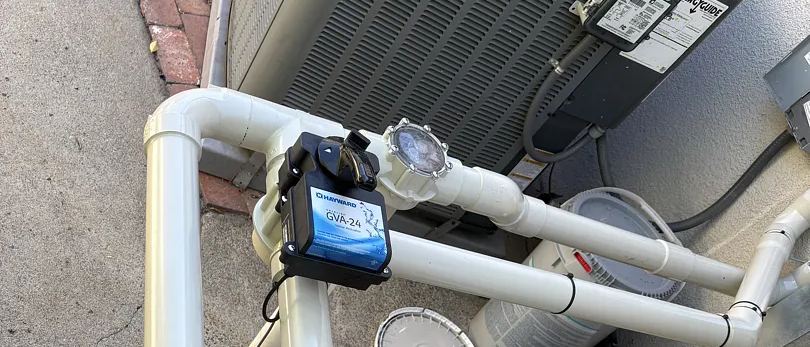
When an actuator stops turning, nothing looks broken. The pump runs, the controller lights up, and the pool stays the temperature it would be with no solar at all.
Is this your problem?
- The pool isn't warming up, even on warm, sunny days
- The valve handle is in the same position every time you look, whatever the weather
- The system seems to run backwards: solar on at night or on a cold morning, and off on a hot afternoon
- The pump runs normally and the filter pressure looks the way it always does
Chasing a leak instead? Start with these quick checks.
Step by step
Check the switch on the actuator
Underneath the actuator there's a small switch with three positions, usually marked ON 1, OFF in the middle, and ON 2. In the OFF position, the actuator ignores the controller and won't move at all.
If yours is set to OFF, you've found the problem: someone bumped it, or switched it off and forgot to switch it back. Move it to ON 1 or ON 2, then use step 3 to make sure you picked the right one.
Make sure the controller is asking it to turn
An actuator that never moves may be fine: maybe nothing is telling it to turn. At the controller, check that it has power, that it's set to automatic (not off or manual), and that the temperature it's set to is at least 5°F above the pool's temperature right now. Set below the pool's temperature, it never calls for heat, and a degree or two above may not be enough either.
Check when your pump runs, too. On most systems the actuator turns whether the pump is running or not, so the pump is rarely why it won't move. But the panels only heat while the pump is pushing water through them, so if it isn't running through the sunny part of the day, the pool stays cold even when everything else is working.
One more: if the roof sensor has failed, the controller may think the roof is cold and never call for heat. A sensor error light, or a roof temperature that can't be true, points to the sensor rather than the actuator. That sensor is up on the roof, so give us a call for that one.
Test which ON is right for your system
ON 1 and ON 2 turn the valve in opposite directions. Which one your system needs depends on how it was plumbed, so we can't tell you from here. On the wrong one, the system runs backwards: water goes up to the panels when it shouldn't, and skips them when it should be heating.
You can usually tell when water is going up to the panels: the pressure gauge on your filter reads a little higher, and you may see bubbles from the pool's return jets for a few minutes while the panels fill.
Test it on a sunny afternoon, when the air is at least 5°F warmer than the pool.
Turn it up. Set the controller at least 5°F above the pool's temperature. Within a few minutes, water should start going up to the panels.
Turn it down. Set it below the pool's temperature. The water should stop going up.
If you see the opposite both times, move the switch to the other ON and test again. The actuator turns slowly and some controllers wait before they act, so give each change time. Can't tell which way the water is going? Call us and we'll talk you through it.
When you're done, set the controller back to the temperature you want.
Look at the wire
Follow the actuator's wire back toward the controller as far as you can see it, and look for damage. Rodents chew them, years of sun crack the outer coating, and a wire can get pinched or cut during yard work. If you find damage, that's very likely the problem, and it's a call for us.
Stop at the controller. Don't open it up or start testing voltages. That's electrical work, so leave it to a professional.
If none of that did it
Then the actuator itself has most likely failed: the motor or the parts inside it. That's usually a replacement rather than a repair, and one of the simpler, less expensive jobs on a solar system.
You can keep swimming in the meantime; the pool just won't get the solar heat. Call us and we'll tell you which way to leave your valve until we get there.
When to stop and call us
- The valve handle is stiff or stuck. Forcing it can crack the valve or tear the seal inside.
- Anything that means opening the controller or touching the wiring inside it
- Water leaking from around the valve
- Anything at all that would put you on the roof
We repair every brand of valve, actuator and controller, on systems we installed and systems we didn't. Book a repair or call (951) 276-8286.
Rather have us fix it?
A tech diagnoses it on-site, you get the price before any work starts, and most repairs are done the same visit.