
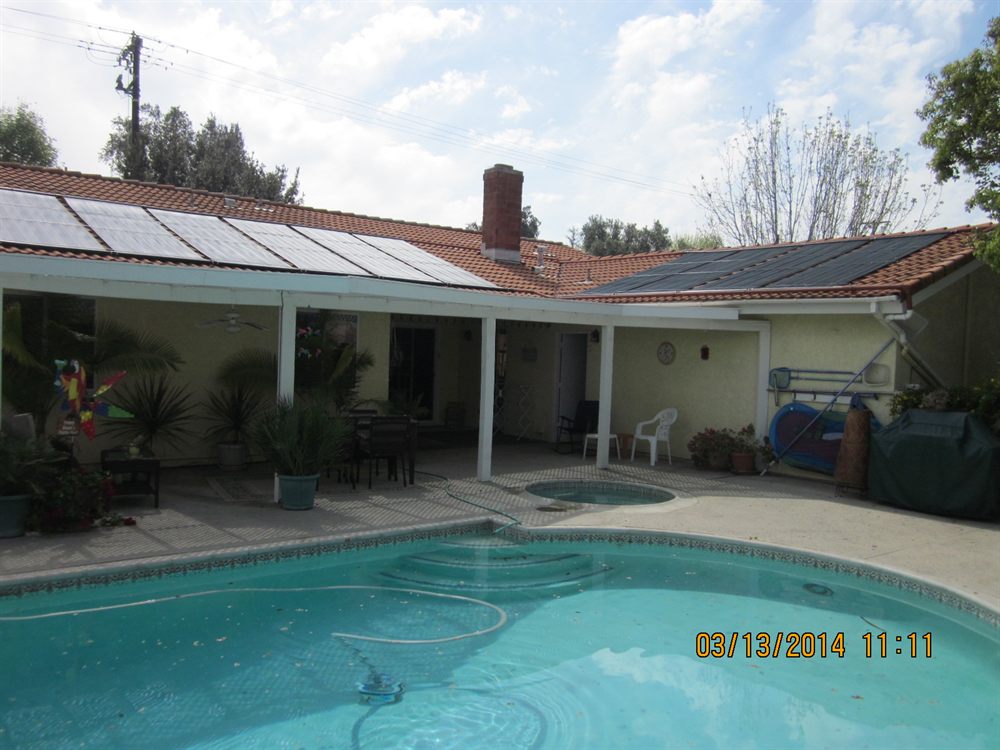
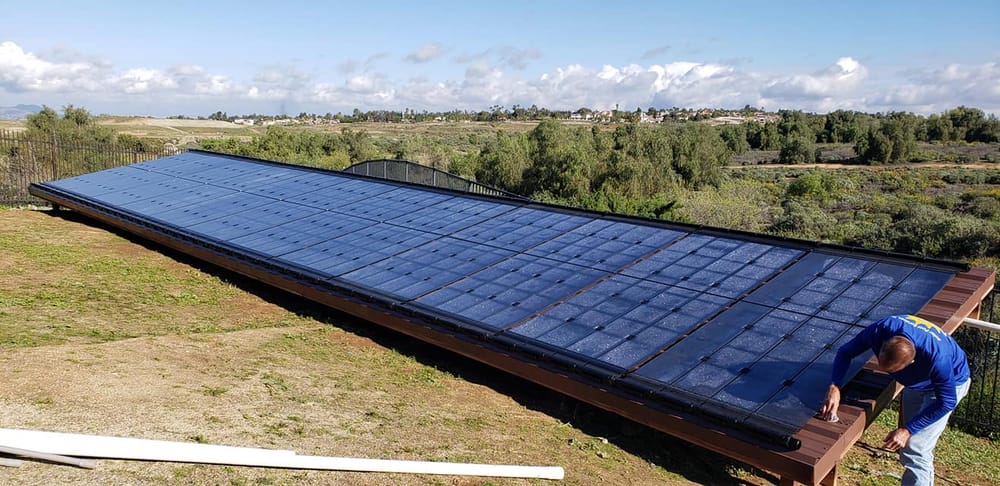
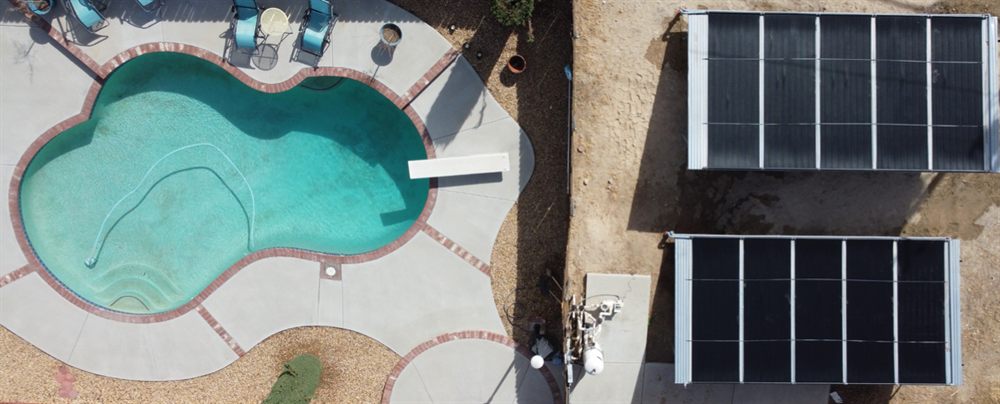
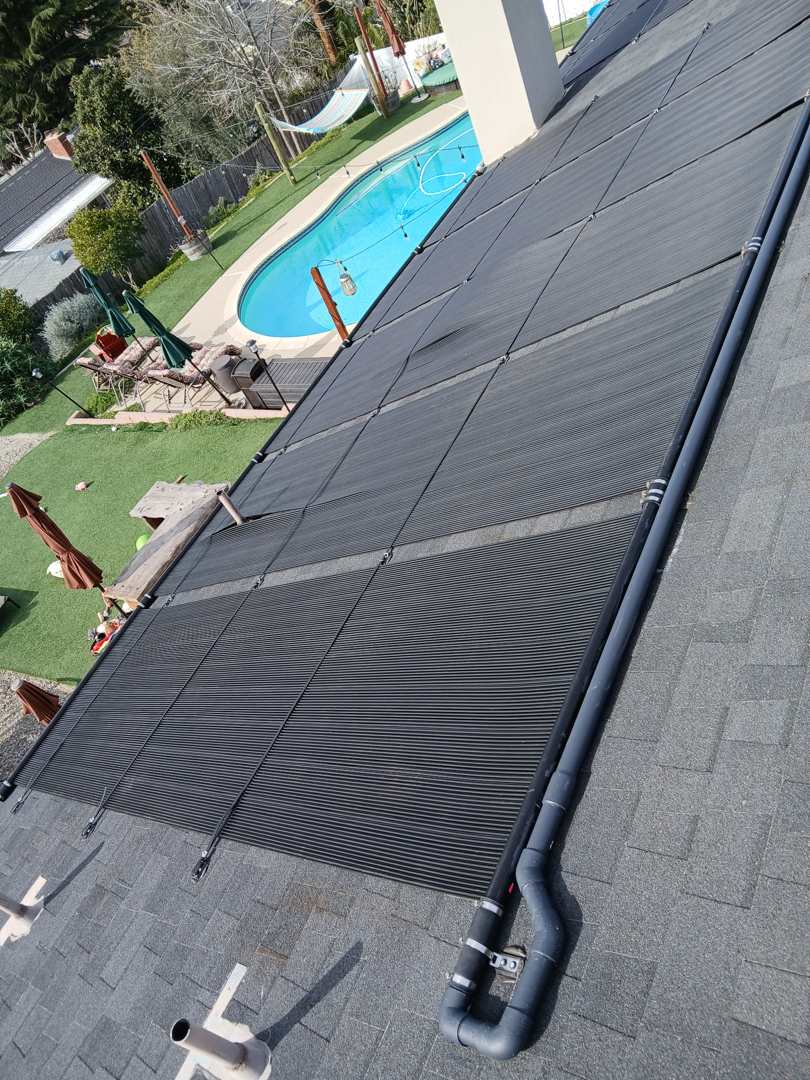
In high summer, our solar-heated pool in Riverside runs between 88 and 92 °F. Across the first three weeks of published readings — July 15 through August 5, 2026 — it started every morning around 85 °F, averaged 89.6 °F during swim hours (noon to 10 PM), and peaked at 92.5 °F. The unheated pool beside it ran about 10 °F colder. Those aren’t estimates: they’re minute-by-minute readings from our own solar pool heating system here in inland Southern California, and you can watch them live, any day of the year, on our live data page.
Search “how warm does a solar heated pool get” and you’ll find the same answer on every page: “78 to 85 °F.” It isn’t wrong, exactly. It’s just nobody measuring anything — that range gets copied from site to site because almost no installer logs what their systems actually do. So this June we decided to be the exception: sensors on our own pool and spa, logging around the clock, published openly. The record is only weeks old, and that’s rather the point — this is the first report, not the last. You don’t have to take our word for any of it; pull up any day and see for yourself.
The setup, so the numbers mean something
The pool is our own: 15,000 gallons at our working installation in Riverside, with a 1,000-gallon spa heated by the same set of roof panels. Sensors log a reading about once a minute, around the clock, to a public record anyone can download. Three rules keep it honest:
- The controls are two unheated pools. One sensor sits in a nearby pool with no heating at all; another in an unheated pool that also sits in shade. Every “boost” figure below is our water minus the shaded control at the same moment — a measurement, not a model.
- No blanket on anything — yet. A cover’s job is keeping heat in, not adding it, and in July the panels add all the heat we need. Every figure here is what solar alone did to bare, open water. (Come the cooler months we’ll add one at night — more on that below.)
- The only gas in the system is a night-time spa boost. We never run the gas heater on the pool — the sun handles the pool entirely. Some evenings we fire it to take the hot tub the last few degrees after the panels have done the day’s heavy lifting. Those stretches — two evenings so far in this record — are flagged automatically and excluded from every solar figure in this article, though the readings themselves stay right there in the charts and the downloadable data.
Logging began June 12, 2026; the published record starts July 15, once sensor placement and calibration were settled. Every day since then is browsable on the live dashboard — pick a date on the calendar and see what the water did.
Measured solar pool heater temperatures: July 15 – August 5, 2026
| Measure | Reading |
|---|---|
| Peak pool temperature | 92.5 °F · July 28 |
| Average pool temperature, swim hours | 89.6 °F |
| Average morning low | 85.4 °F |
| Coolest the pool got, any hour of any day | 83.4 °F |
| Swim-ready days (≥ 82 °F averaged over swim hours) | 22 of 22 |
| Unheated shaded pool, same test | 0 of 22 |
| Average boost over the unheated pool | +10.2 °F |
| Biggest boost recorded | +16.2 °F · July 29 |
A typical day goes like this: the pool bottoms out in the mid-80s just after sunrise, the panels go to work with the morning sun, and most afternoons the water tops 90 °F. It holds well into the evening, too — swim hours here run noon to 10 PM, and the average across all of them was 89.6 °F. The floor is as telling as the ceiling: in three weeks the water never once dropped below 83.4 °F, at any hour, and the worst afternoon of the record still peaked at 88.7 °F.
The honest part: we cap it at 90 °F
That 92.5 °F peak isn’t the system running out of sun — it’s the system running past the limit we set. Our controller stops sending water to the roof once the pool nears 90 °F, because that’s where we like our pool: warm at 7 AM, still refreshing on a 100 °F afternoon. That’s the consistency you see in the table — the water sits right where we want it, day after day, without us touching anything. On hot days it coasts a little over the line anyway. Want proof there’s more heat on the table? The spa runs on the same panels with a 100 °F limit, hit that limit on 20 of its 20 gas-free days, and topped out at 105.4 °F on sunshine alone. In July, “how warm does a solar-heated pool get” has a slightly ridiculous answer: as warm as you’ll allow. The sun isn’t the limit; your comfort setting is.
How many degrees does solar pool heating add?
This is what the control pools are for. During swim hours our pool averaged +10.2 °F over the unheated shaded pool beside it, and the biggest gap we recorded was +16.2 °F. The spa — same panels working on 1,000 gallons instead of 15,000 — averaged +18.1 °F over the control and once reached +26.8 °F. For years the industry’s rule of thumb (ours included) has been “solar adds 10 to 15 degrees.” Measured: +10.2 °F on the average afternoon, +16.2 °F on the best one. The old line holds up.
Keep in mind two things holding that number down. The +10.2 °F was measured with the pool capped at 90 °F — through the warmest hours of most of these days, the panels were being told to stand down, not running out of heat. And the array is doing two jobs at once, splitting the sun between the pool and a spa it takes to 100 °F nearly every day. Uncapped, on the pool alone, the gap would be wider. How much wider, we can’t say yet — we don’t publish numbers we haven’t measured.
Two more honest footnotes. Our pool sits in shade most of the day, so we compare against the shaded control — that’s what this pool would be doing without solar. If your pool bakes in full sun, unheated water warms itself further on its own, and the gap solar has to close is smaller. And averages undersell the practical difference anyway: the unheated shaded pool didn’t manage a single swim-ready day in 22 tries. The solar-heated pool didn’t miss once.
What changes these numbers for your pool
- Where you are. Riverside summers are solar’s best case — long, bright and hot. Near the coast, cooler air and marine-layer mornings pull a few degrees out, which is why coastal systems get sized with more panel coverage.
- Shade. Worth noticing: every number above came off a pool that sits in shade most of the day. That’s the harder job. A pool in open sun starts warmer before the panels do anything.
- Panel coverage and roof direction. More panel area relative to pool size heats faster and holds higher; south- and west-facing roofs catch the most sun. Matching both to your pool is most of what a quote works out.
- A blanket — for keeping heat, not making it. That’s the pairing we recommend to everyone: solar pool heating to put degrees in, a cover to stop losing them overnight. In high summer our panels keep up without one, so every number above is open water. When the cooler months come we’ll blanket our own pool at night — typically worth another 3 to 6 °F, right when you want it — and you’ll see it happen in the data.
- The calendar. This record is high summer, solar’s easiest test. Which brings us to the honest gap in this article.
What we can’t tell you yet
Anyone can swim in Riverside in July. The real question is how far solar pool heating stretches the season into spring and fall — and honest data on that takes a year to collect, not three weeks. We’re three weeks in. As the record runs through the cooler months we’ll publish follow-ups from these same sensors: what a blanket adds at night, what November mornings look like, when the season really ends and comes back. Don’t wait on us, though — the live dashboard updates every minute of every day, including the days that won’t flatter us, and you can pull up any date since July 15 and judge the water for yourself.
Measured July 15 – August 5, 2026: 22 days, 22 swim-ready. This is a living article — we’ll keep updating it as the record runs through the seasons.
Want to know what solar would do for your pool? See how a system works, design your own system, or call (951) 276-8286. We’ve been heating Southern California pools since 1981 (C-46 License #924564) — and the pool in this article is ours: watch it live, or come feel the water for yourself.