Most contractors won't give you a number over the phone. We will, because the range is narrower than people expect and you deserve to know whether this is a $5,000 conversation or a $15,000 one before anyone comes out. Here's what we actually charge, and — more usefully — what moves your particular quote up or down inside that range.
| Pool size | Typical installed cost |
|---|---|
| Small | $5,000 – $7,000 |
| Medium | $7,000 – $8,000 |
| Large | $8,000 – $10,000 |
Those are real installed prices for a standard job — panels on the roof, plumbed to your existing equipment, no complications. They're the numbers we quote across Riverside, Orange, and San Bernardino counties. A straightforward install lands in that range most of the time. The rest of this guide is about what pushes a quote toward the top of it, or past it.
1. Pool size and how much of it you cover
This is the big one, and it's why the table above is organized the way it is. Panel area is sized against the surface area of your pool, because that's the surface losing heat.
Two different coverage numbers get quoted in this industry, and they are not the same thing:
- 60% is the Title 24 code minimum — 0.6 square feet of panel for every square foot of pool surface. It applies only if you're pairing the pool with a gas heater; without one, there's no requirement at all. Our panels meet it.
- ~80% is what we actually size to, because that's what it takes to heat the water the way you're expecting.
The first number keeps a building inspector happy. The second one makes the pool warm in May. If someone quotes you the code minimum and calls it a heating system, they've answered a different question than the one you asked.
You can go smaller than 80%. It just doesn't work as well, and it's the most common way an underpriced quote gets to be an underpriced quote. A system covering half your pool will warm it a few degrees on a good day and disappoint you in May and October — the exact months you bought it for. If a bid comes in well under the range above, the first thing to check is the panel count.
2. Roof or ground mount
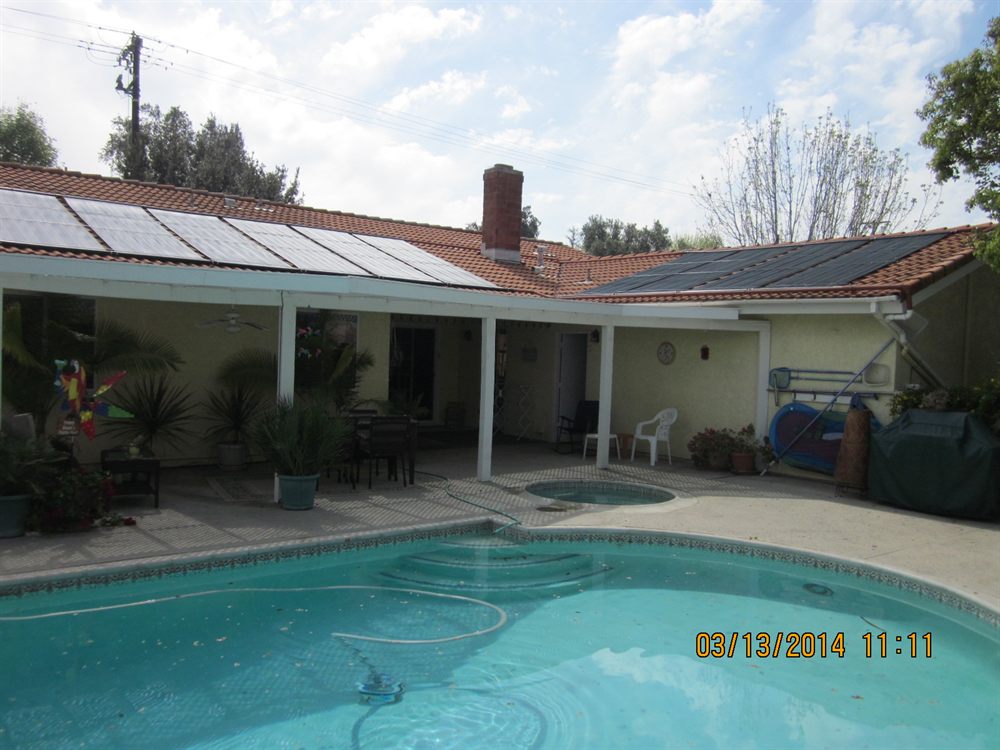
A roof-mounted system is the standard job and the cheaper one: the roof is already there, already angled, and already in the sun. Panels attach directly to it with standard mounting hardware and materials.
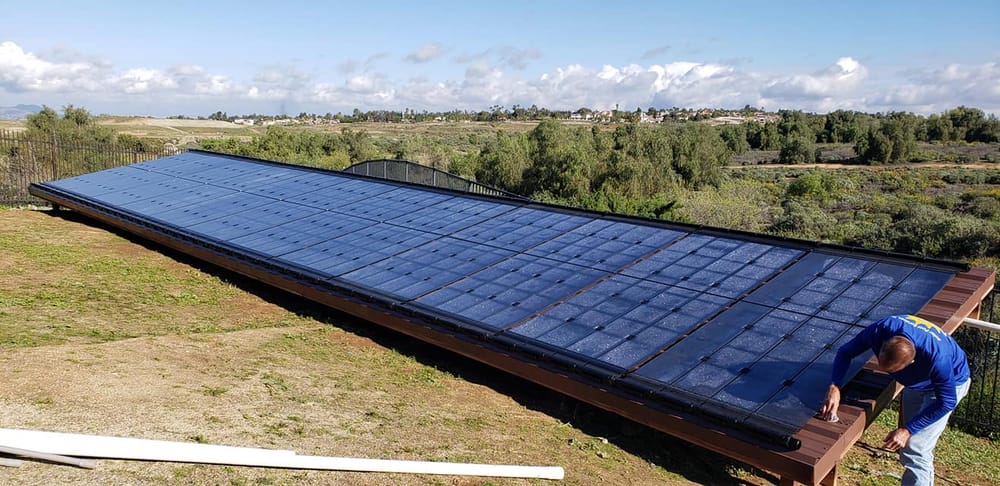
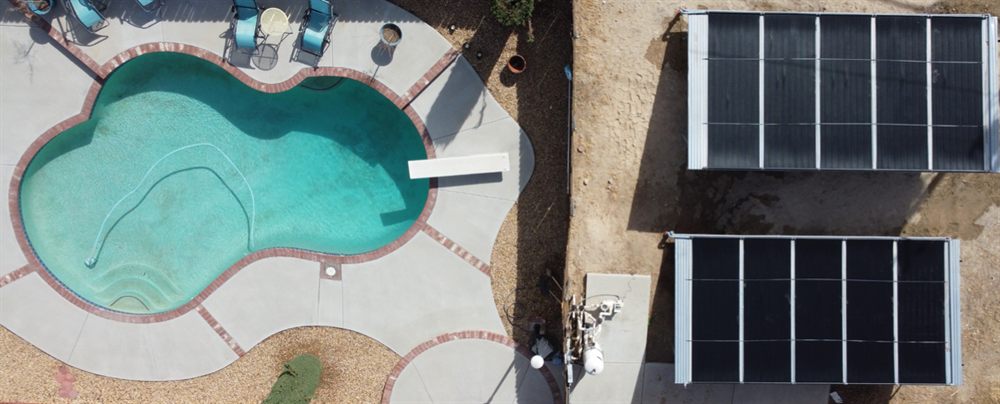
A ground mount is what you do when the roof won't work — too shaded, too small, wrong orientation, or a tile roof the owner would rather not touch. It means building a rack: a support structure that has to be engineered, fabricated, anchored, and paid for. That's real material and real labor, and it's the single most common reason a quote lands above the range in the table.
3. How far the water has to travel
Your equipment pad is in one place and the panels are in another, and the pipe between them costs money. A pad sitting right below the array is cheap. A pad on the opposite side of the house from the only usable roof is not.
If that run has to cross a driveway, a patio, or a finished yard, it may need trenching — cutting, laying pipe, and putting the surface back. Trenching is priced separately for a reason: it varies enormously depending on what's in the way, and it's the line item most likely to surprise someone who only got a verbal ballpark.
4. Which way the roof faces
South-facing is ideal and is what standard pricing assumes. East- and west-facing roofs work perfectly well, but they need roughly 20% more panel coverage to deliver the same heat — more panels, more mounting, more plumbing, a higher number.
Split arrays cost more too. If the only way to fit enough panel area is to put some on one roof face and some on another, that's two arrays to mount and plumb instead of one.
5. What's actually in the system
A complete system isn't only panels. It's panels, the plumbing to and from them, the valves that route water to the roof or bypass it, and a controller that decides which of those happens. When you compare two quotes, check that both include the controller and the valve work — an automatic system that decides for itself when to send water to the roof is not the same product as one you switch by hand, and the difference tends to hide in the fine print.
What the price gets you
Our installed price includes the design, the panels, the plumbing, the valves and controller, the mounting, and the labor. The panels carry a 12-year manufacturer warranty and we back the installation with a 1-year full workmanship warranty. A typical residential job is done in a day.
We're licensed, bonded, and insured under C-46 Solar Contractor license #924564 — search it on the CSLB site — which you can and should verify, for us or anyone else bidding your job. Our guide on choosing a company covers the rest of what to check before you sign.
Is it worth it?
A gas heater costs less to install — $2,500 to $5,500 — and then bills you several hundred dollars a month during the season, indefinitely. Solar costs more up front and then costs approximately nothing to run, which is why it typically pays for itself within two to four swimming seasons of regular use and then keeps going for the rest of its 12–20 year life.
That's the trade. You're choosing a bigger first check in exchange for not writing the monthly one. If you swim regularly and plan to stay in the house, it's usually the cheaper option over the years you actually own the pool. If you swim twice a summer, it may not be, and we'd rather say that now.
Replacing a system costs less than the first one
Panels don't last forever, but most of what holds them up does. When a system reaches the end of its life, a replacement typically runs 25–40% below what the original installation cost — because you're paying to replace the part that wore out, not to build the whole thing over again.
The two-piece aluminum header brackets are the clearest example. Aluminum doesn't break down in the sun the way the panels themselves eventually do, so a good set of brackets outlasts several sets of panels and gets reused as-is. Much of the mounting hardware, and the plumbing run between the equipment pad and the roof, usually comes through fine too. On a replacement we reuse what's still good and charge you only for what isn't — how much that saves depends on how the original was built and how it's held up, which is something we look at before quoting, not after.
That changes the long-run math more than the first number suggests. The original system pays for itself in two to four seasons and then runs essentially free for the rest of its 12–20 years; the one that follows it starts from a lower price and does the same thing again. The second and third decades of heating the pool cost less than the first.
Want a number for your pool instead of a range? Build an estimate online — you trace your pool on a satellite view and it prices the real roof run — or call us at (951) 276-8286 and we'll talk it through. No obligation either way.