Update, October 2026: Magen has bought LeverEdge's solar pool heating business, so the leading manufacturers named below are now Aquatherm and Magen. Here's our take on the news.
We're brand neutral — we install and service every major panel. At the end of the day, we'll recommend whichever panel is best for your situation, not whichever one we happen to sell. And here's the honest truth about the top of the market: the leading panels are effectively the same. It mostly comes down to price.
Those leading manufacturers are Aquatherm, Leveredge, and Magen. Below is how we evaluate them — and any panel — after 40+ years of installing, repairing, and replacing solar pool heating systems.
The three things that actually matter
1. Quality of construction and materials
A manufacturer standing behind their panels with a 12-year full warranty is the best indicator of their faith in their own product. Most manufacturers honor that warranty only when a licensed contractor installs the system — our guide on choosing a company covers how to check.
2. Repairability
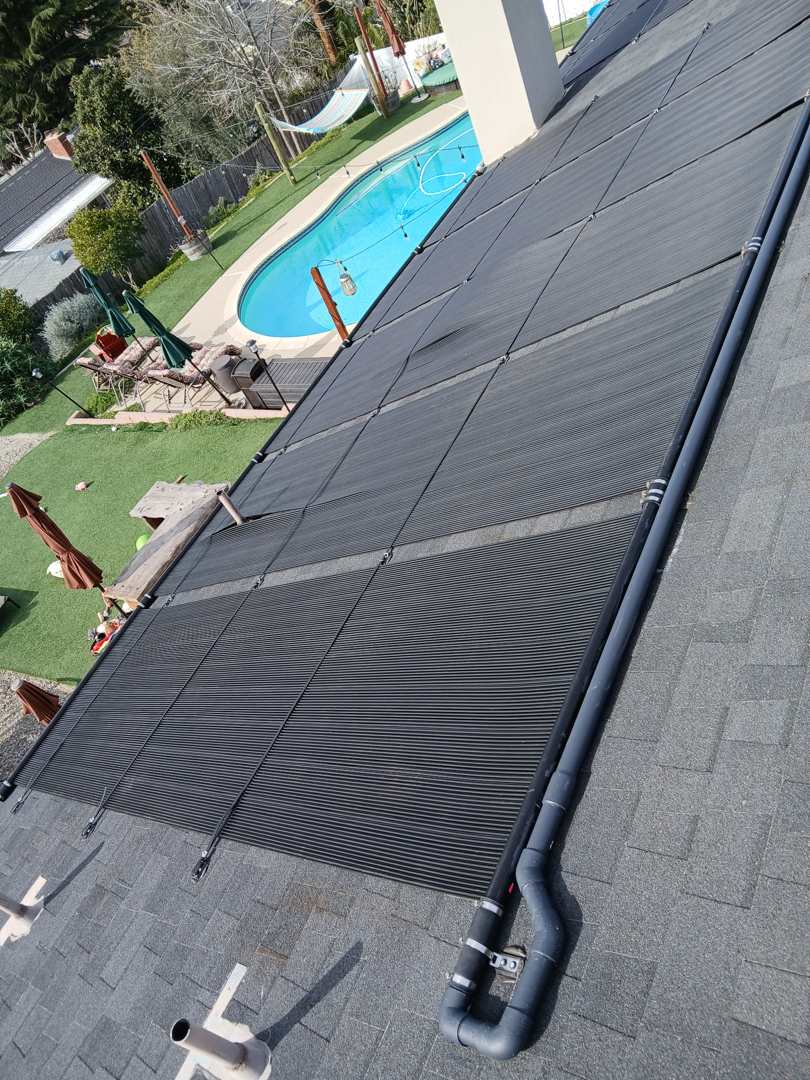
It's not just about the panels. A system is only as repairable as everything that supports it — the couplers and clamps between panels, the mounting hardware, the valves, and the plumbing that ties it all back to your equipment pad. Every one of those parts has to be serviceable today, and still serviceable years from now. Because leaks will happen.
A few minor repairs after the 12-year warranty runs out can greatly extend the lifespan of your system — so a panel that can't realistically be repaired shouldn't be considered at all. Individual tubes should be pluggable, and the couplers between panels replaceable. Avoid panels with screw-on header couplers or non-circular tubes — Techno-Solis, SunLink, and Sunquest, for example.
Rubber couplers should always be used between panels. They absorb the uneven strain of panels expanding and contracting at different rates — which they do, every single day.
3. Cost
The larger the panel, the more cost-effective it is. A single 4′×12′ beats two 2′×12′s.
And even if you plan to install the system yourself, buy your panels from a local solar pool panel installer or distributor. Panels this large aren't economical to ship — even with careful packaging, shipping can add close to $100 per panel. On an average system of 6 to 10 panels, that adds up fast.
What to look for, component by component
Three parts of a panel decide how long your system lasts and how easy it is to keep running.
Waterways (the tubes)
You want circular tubes that can be plugged with a screw or a manufacturer-made plug. Plugging even several leaking tubes blocks only a couple out of hundreds in a panel — reducing heating capacity by a sliver of a percent while adding years to its life.
Look for: round, pluggable tubes. Avoid: non-circular tubes that can't be plugged.
Panel couplers
Flexible, durable rubber couplers are the gold standard. Your panels need to expand and contract individually — which they do naturally every day as the sun rises and falls — and no two panels ever move at exactly the same rate. Shade from trees, debris, clouds, vents, and chimneys all see to that.
Look for: flexible rubber couplers. Avoid: solid or screw-on couplers, especially threaded union-style connections.
Header clamps
Think ahead to the repair or replacement your system will eventually need. A one-piece C-clamp has to be slid off the end of the header — so pulling one panel out of the middle of your array means disassembling every panel between it and the edge. Two-piece brackets come apart in place, so any panel can be lifted out on its own.
Look for: two-piece aluminum header brackets — the gold standard for durability and easy maintenance. Avoid: one-piece C-clamps and other slide-off brackets.
Which manufacturer fits your situation
As of July 2026, three manufacturers make our shortlist. Rather than ranking them, match each to the job in front of you:
Aquatherm — our go-to for most new installations
Solar Industries. Stands behind its warranty without making you jump through hoops, and stays incredibly repairable long after the warranty ends.
Leveredge — best when replacing an existing Leveredge system
SwimMaster Pro, also private-labeled as SwimEasy. A strong second choice — durable, repairable panels that check every box above. And if you're replacing an existing Leveredge system, staying with Leveredge is usually the smart move: the new panels reuse your existing roof penetrations, so nothing new gets drilled into your roof.
Magen — best for jobs that call for loose-tube panels
SunStar, also private-labeled as SwimJoy. Our pick when a job calls for loose-tube panels — flat systems and other spots that need to shed wind. The trade-off: loose-tube panels are stringy and hard to handle, so installation takes extra care.
Considering a panel that isn't on this list? Give us a call at (951) 276-8286 — we love all things solar. Even if you're well outside our service area, one of our experts will happily give you free advice.
The exceptions: when a specialty panel makes sense
A few situations call for a different type of panel:
Semi-glazed (no longer made — see the note below)
For: consistently strong, chilly winds — like directly on the beach. Trade-offs: significantly more expensive; difficult and sometimes impossible to repair.
Loose tube
For: flat systems and other spots where shedding wind loads is necessary. Trade-offs: less efficient heating; stringy and hard to handle; a bit more flimsy and prone to pest damage.
Rubber mat systems
For: using up every possible square foot on a really choppy roof. Trade-offs: the glue typically isn't strong enough to hold, so you end up with a weird spaghetti mix on your roof; poor durability, long-term survivability, and cost-effectiveness. We typically won't install this kind of panel.
A note on semi-glazed: as far as we know, these kinds of panels are no longer being made. Our best guess why: the cost, the repair problems, and a market limited to a narrow band of windy sites.
Those situations are the outliers. 95% of new installations should use standard full-body, unglazed panels — the optimal balance of heating, repairability, and cost.
Why Aquatherm is our go-to right now
We'll switch if another brand or panel becomes the top contender. But currently, Aquatherm's Solar Industries panels are what we reach for. That said, we're happy to install panels from any of the other leading manufacturers if you prefer — we keep a large stock of each, because we service all brands.
We really feel Aquatherm confidently stands behind its warranty. Unlike some manufacturers, they're fast to own up to their mistakes, and they keep the process simple — no jumping through hoops. And even after their panels have exceeded the warranty, they're incredibly repairable:
- Individual tubes plug easily with a manufacturer plug or a correctly sized screw.
- Rubber couplers can be replaced or readjusted cheaply and easily.
- Header brackets come apart by removing a single nut — without disassembling your whole system.
When you're comparing systems, ask one question about every part: what would it take to repair or replace this? A system that's hard to take apart almost always has a higher total cost of ownership than one that comes apart easily.
Aquatherm is the leader on that front. Leveredge is a strong second — and the natural pick when you're replacing an existing Leveredge system — while Magen is who we reach for when a job calls for loose-tube panels.
Not sure which panel fits your pool? Build an online quote or call us at (951) 276-8286 — honest pricing, no hidden fees. Our cost guide covers what a full system runs installed.